

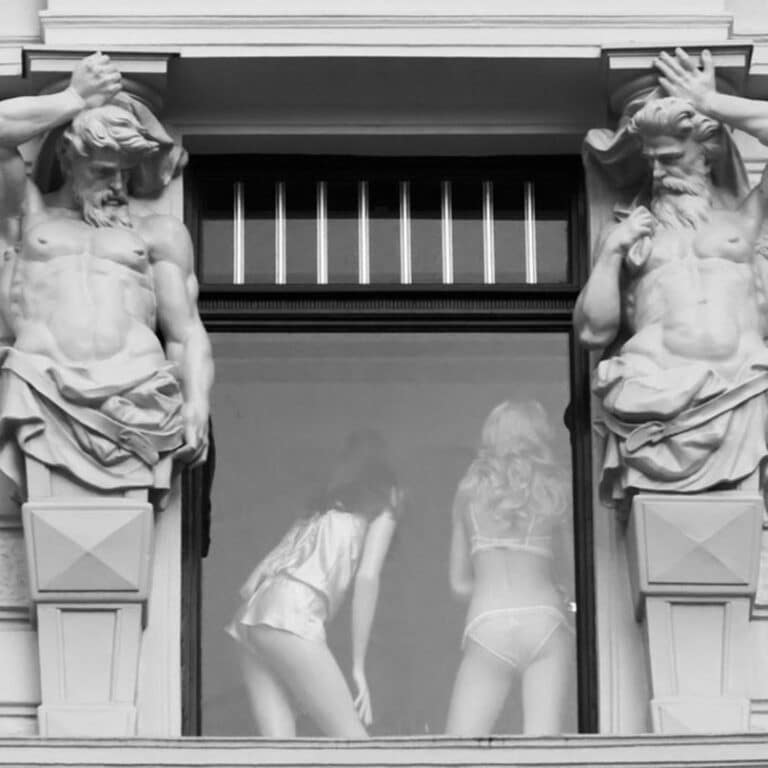
Almost all of us have been stunned by a beautiful art at least once in our lives. When you look closely, you don’t know how someone could make something so beautiful and important. Artists help us make sense of the chaos of cities and bring our thoughts together. They make us pause, think, and forget about how busy we are.
Loknam would like to show you 43 statues that can change the way you think by putting you in the world of the artist.
“If you do not see your own beauty yet, do as the sculptor does with a statue which must become beautiful: he pares away this part, scratches that other part, makes one place smooth, and cleans another, until he causes a beautiful face to appear in the statue. In the same way, you too must pare away what is superfluous, straighten what is crooked, purify all that is dark, in order to make it gleam. And never cease sculpting your own statue, until the divine light of virtue shines within you” (Plotinus)
-
Advertisement
1 Angel; at the Altar of the Annunciation
This is one of the two angels at ground level at the Altar of the Annunciation; it is the work of Pietro Bracci. In the background is the 'Annunciation' bas-relief by Filippo della Valle.
-
Advertisement
2 dorota piotrowiak art
-
Advertisement
3 "Woman Bitten by a Snake" by Auguste Clésinger (1814-1883)
-
Advertisement
4 Sculpture in the cemetery
-
Advertisement
5 "Angel of Sorrow" by William Wetmore Storey for the tomb of his wife Emeline Storey.
-
Advertisement
6 "Paul and Virginia" (1844-45), Alessandro Puttinati
-
Advertisement
7 Fountain of Neptune, Italy
-
Advertisement
8 Eternity with you
-
Advertisement
9 Bronze statue "LILITH" in Malbork Castle, Poland.
-
Advertisement
10 Gargoyles reading books
-
-
Advertisement
12 Bust of Samuel Bernard (c. 1727) by Guillaume Coustou the Elder 🏛Metropolitan Museum of Art
-
-
Advertisement
14 "Adoration" (1903), Stefan Sinding
-
Advertisement
15 Satan", Jean-Jacques Feucher, 1835
-
Advertisement
16 "The Witch", 1874, Karl Kauer
-
-
Advertisement
18 Lost in the waves
The underwater sculpture museum is not the first time they show it and it is always very impressive, it looks fantastic and the most interesting things are perceived differently, from light, water, weather..., nature changes colors so much, from horror and fear to delight and admiration
-
Advertisement
19 When I die, I want a statue of an angel on my grave.
-
Advertisement
20 Nymph of the Woods and Nymph of the Fields. Carlo Pittaluga, 1915.
-
Advertisement
21 Nymph of the Woods and Nymph of the Fields. Carlo Pittaluga, 1915.
-
Advertisement
22 Fall of the Angels, 1780, St. Michael's Church, Vienna:
-
Advertisement
23 "The Ecstasy of Saint Teresa"
"The Ecstasy of Saint Teresa" The sculptural group was created in 1645-1652 by the outstanding sculptor of the Italian Baroque Gian Lorenzo Bernini
-
-
Advertisement
25 "The Veiled Angel of Death" by Augustus Lukeman
-
Advertisement
26 "Hero and Leander" (Hero und Leander), ca. 1850.
"Hero and Leander" (Hero und Leander), ca. 1850.
Karl Johann Steinhäuser (1813-1879) -
a famous German sculptor of the classical style.
Material: marble. Charlottenburg Palace, New Wing. Berlin. -
Advertisement
27 Sculptor Benjamin Victor
-
Advertisement
28 Sculptor Benjamin Victor
-
Advertisement
29 Ernest Barrias, 1894
-
Advertisement
30 Montjuic Cemetery and its sculptures, Barcelona.
-
Advertisement
31 "Flower Work" (detail), Jean-Michel Bihorel
-
Advertisement
32 "Sylvie" by Prosper d'Epinay (1836-1914) - French sculptor.
-
Advertisement
33 Sculpture called "Eternal Waiting" by Italian Sasha Vinci
-
Advertisement
34 "Sleeping Penelope" (1848-1849), Pierre-Jules Cavelier
-
Advertisement
35 Sculptor of floating wood
-
Advertisement
36 Joan Coderch and Javier Malavia - "My Life is My Message"
-
Advertisement
37 Sculptural composition "Minotaur", Emil Alzamora
-
Advertisement
38 Statues carved from marble
-
Advertisement
39 Statues carved from marble
-
Advertisement
40 Statues carved from marble
-
-
Advertisement
42 Pierre Julien - The Dying Gladiator, 1779, Rome
-
Advertisement
43 "The Longing of a Fugitive", 1914, Ruperto Banterle
